Last updated October 28, 2026
A contact lens prescription is a specialized educational document that specifies the power, base curve, and diameter needed for a lens to fit your eye. It differs from a glasses prescription because contacts sit directly on the cornea, requiring unique measurements to support comfort, ocular health, and clear vision.
Table of contents
- Key takeaways
- Understanding the Components of Your Prescription
- Why Glasses and Contact Lens Prescriptions Differ
- Your Rights Under the FTC Contact Lens Rule
- Prerequisites for a Fitting in San Diego
- 1. Schedule a comprehensive eye health exam
- 2. Complete the contact lens evaluation and mapping
- 3. Finalize your prescription after a trial period
- Common Mistakes to Avoid With Lens Prescriptions
- Frequently asked questions
Key takeaways
- Unique Measurements. Contact lens prescriptions include specific fit data like Base Curve (BC) and Diameter (DIA) that are absent from glasses prescriptions.
- Legal Requirements. The FTC Contact Lens Rule mandates that your optometrist provides a copy of your prescription immediately after the fitting process is complete.
- Brand Specificity. Prescriptions are tied to specific brands and materials because each manufacturer’s lens interacts differently with your eye’s physiology.
- Separate Services. A standard eye exam evaluates health and vision, but a contact lens evaluation is a distinct service required to finalize a lens prescription.
- California Validity. In California, these prescriptions are valid for a limited duration to help maintain ongoing monitoring of corneal health.
Understanding the Components of Your Prescription
A contact lens prescription consists of several standardized measurements including sphere power, base curve, and diameter, which are listed alongside notations for each specific eye. These values inform the manufacturer how to build a medical device that corresponds to the unique topography of your cornea. The most basic notations you will see are Oculus Dexter (OD), which refers to your right eye, and Oculus Sinister (OS), which refers to your left eye.
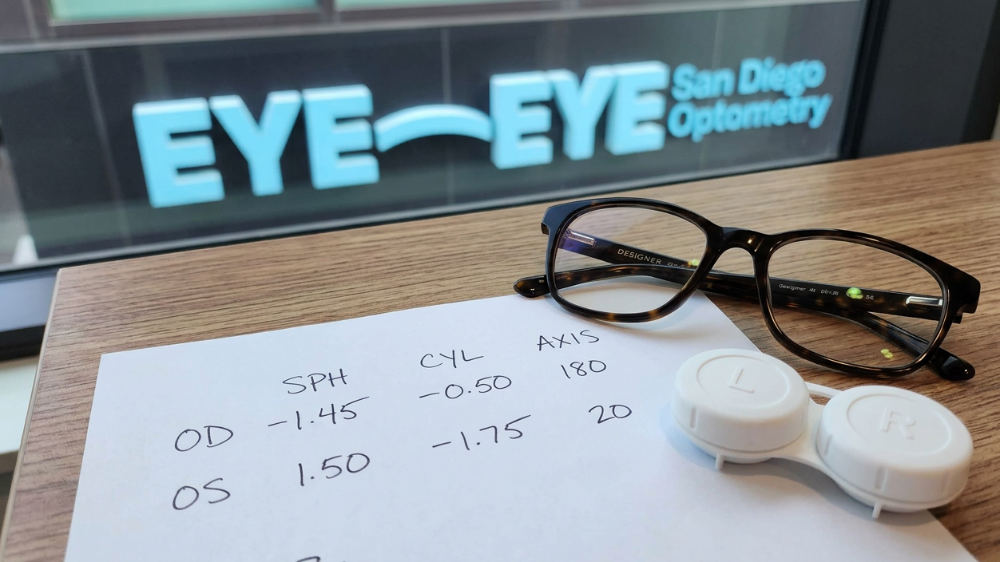
- Sphere (SPH). This indicates the lens power required to support vision for nearsightedness (indicated by a minus sign) or farsightedness (indicated by a plus sign), measured in units called diopters.
- Base Curve (BC). According to Warby Parker, Base Curve (BC) measurements typically fall between 8 and 9 millimeters. This number determines how the back of the lens aligns with the curvature of your cornea.
- Diameter (DIA). This specifies the total width of the lens in millimeters, helping the edges sit correctly on the eye to support comfort.
- Cylinder (CYL) and Axis. If you have Astigmatism, these values will appear on a toric lens prescription. The cylinder measures the degree of astigmatism, while the axis (0 to 180 degrees) indicates the orientation required to support the eye’s shape.
- Add Power. For those experiencing Presbyopia, an "Add" value is included for multifocal contact lenses to support near-vision tasks like reading.
Why Glasses and Contact Lens Prescriptions Differ
Glasses and contact lens prescriptions differ because the distance between the corrective lens and the eye changes the required optical power. While glasses sit a short distance from the face, contacts rest directly on the eye’s tear film, necessitating a change in the SPH value. Furthermore, contacts are medical devices that require specific physical fit parameters to support the health of delicate corneal tissue.
- Medical Device Status. Unlike glasses, a contact lens is a medical device that requires a specific brand and material designation. A prescription must specify a manufacturer like Alcon or CooperVision because the physical properties of the materials vary.
- Physical Dimensions. Glasses frames can be adjusted behind the ears or at the nose bridge, but a contact lens must be manufactured to fit your eye’s unique topography. If the Base Curve (BC) is off by even a fraction of a millimeter, it can affect how the lens sits on the eye.
- Material Science. The choice between silicone hydrogel vs hydrogel is a clinical decision. Silicone hydrogel allows more oxygen to reach the eye, which helps maintain long-term corneal health.
- Optical Zones. For patients with presbyopia, multifocal contact lenses use concentric zones to support vision at multiple distances simultaneously. This is a different optical approach than the top-to-bottom split found in bifocal glasses.
San Diego Pro-Tip: For the active San Diego lifestyle, clinicians often suggest silicone hydrogel lenses which allow more oxygen to the eye, helping maintain comfort during long days at the beach or in dry inland heat.
Your Rights Under the FTC Contact Lens Rule
The Federal Trade Commission (FTC) Contact Lens Rule grants patients the right to receive a copy of their prescription immediately following a fitting, regardless of whether they ask for it. This federal law is designed to promote competition and allow consumers to shop for lenses at the provider of their choice. It ensures that the eye doctor who performs the evaluation provides the prescription once the fitting process is finalized.
- Automatic Release. According to the FTC Contact Lens Rule, prescribers must provide a copy of the prescription at the completion of a fitting, even if the patient does not ask for it.
- No Purchase Requirement. An eye care practice cannot require you to purchase a year’s supply of lenses as a condition for releasing your prescription or providing an exam.
- Verification of Fit. A fitting is only considered "complete" once the optometrist has confirmed the lenses fit properly. This may involve a trial period of a week or two to monitor the eye’s response.
- Required Details. To be valid for use at third-party retailers, a prescription includes the brand name, power, base curve, and diameter.
Legal Right: Under the FTC Contact Lens Rule, your eye doctor must give you a copy of your contact lens prescription as soon as the fitting is complete, without you having to ask for it.
Prerequisites for a Fitting in San Diego
Securing a new prescription requires more than just a quick vision check. Before a fitting can be finalized, general clinical guidelines suggest a current comprehensive eye health exam performed within the last year to ensure the eyes are suitable for lens wear. Optometrists use diagnostic tools to map your corneal shape, helping ensure the lens supports your vision throughout the day.
- Time Investment. A comprehensive exam and initial fitting requires a scheduled appointment and focused evaluation. You should also budget time for a follow-up evaluation roughly 1 to 2 weeks later.
- Associated Costs. Expect a separate fitting or evaluation fee in addition to the standard eye exam cost. This covers the specialized corneal mapping, trial lenses, and follow-up care.
- Trial Lenses. Eye care providers typically provide a set of trial lenses to allow you to evaluate the comfort and clarity in your actual daily environment, such as while working in an office or exercising.
- Lifestyle Assessment. During the process, optometrists evaluate a patient’s daily routine to determine if daily disposables, bi-weeklies, or monthly lenses may best suit their needs.
1. Schedule a comprehensive eye health exam
The process begins with a baseline health check to ensure your eyes are suitable for contact lenses. Inform your provider at the start of the appointment that you intend to wear contact lenses. They will include the necessary corneal measurements in their workflow. Eye care clinics often evaluate how environmental factors, like the dry Santa Ana winds, might affect your eye’s tear film. During this visit, you can also browse our designer eyewear if you need a backup pair for when you aren’t using your contacts.
2. Complete the contact lens evaluation and mapping
During the contact lens evaluation, the doctor measures the curvature of your cornea using keratometry or digital corneal topography. This mapping helps in selecting the appropriate Base Curve (BC) and Diameter (DIA). Once the measurements are taken, initial trial lenses are applied in the office. The doctor will use a slit lamp (a specialized microscope) to check for proper lens movement, centration, and initial comfort. Following initial fittings, clinicians perform follow-ups to help ensure the selected lenses support the eye across varied climates.
3. Finalize your prescription after a trial period
After the initial office visit, you will typically wear your trial lenses for about a week. This real-world evaluation helps determine if a lens supports moisture and clarity over an 8 to 12-hour day. You will then return for a short follow-up visit where the optometrist checks the corneal surface to ensure the lens is sitting correctly. Once the fit is confirmed, the doctor signs off on the final prescription. You will receive a printed copy that includes the brand, power, and fit parameters, giving you the freedom to order your supply wherever you choose.
Common Mistakes to Avoid With Lens Prescriptions
One of the most frequent errors is attempting to buy contacts using a glasses prescription. Because glasses lack the specific parameters for base curve and diameter, using those numbers to order contacts can lead to lenses that do not fit correctly, which may lead to irritation or corneal stress.
- Brand Swapping. Patients should be aware that brands are not always interchangeable. Different brands use unique edge designs and moisture-retention technologies. Switching without a professional evaluation may affect comfort.
- Ignoring Expiration Dates. Contact lens prescriptions in California are valid for a specified period. Adhering to the expiration date helps maintain corneal health through regular monitoring.
- Skipping Follow-ups. The final follow-up is an important part of the process. A lens that feels okay initially requires professional evaluation to ensure it supports the corneal surface properly over time.
If you are looking to update your vision and help maintain your eye health, book an appointment online or call 619-815-5864 to schedule your fitting.
Frequently asked questions
How do I get a contact lens prescription in San Diego?
To get a prescription, schedule an appointment for a specific contact lens fitting San Diego. The process involves a comprehensive health exam, precise corneal mapping to help determine fit, and a trial period where you test specific brands to ensure they support comfort and ocular health.
Does a standard eye exam include a contact lens prescription?
No, a standard eye exam focuses on internal eye health and the refractive error used for glasses. A contact lens fitting is a separate service that requires additional measurements and diagnostic evaluations of how a lens interacts with your eye. Because this involves more time and specialized equipment, it typically carries a separate fee.
Can I buy contacts with a glasses prescription?
No, it is not recommended for safety reasons. A glasses prescription lacks the essential base curve and diameter measurements needed to help ensure a lens fits your eye safely. Additionally, because contacts sit directly on the eye, the power (SPH) is often different than what is listed on your glasses prescription.
How long is a contact lens prescription valid in California?
In California, a contact lens prescription is valid for a set timeframe from the date the fitting is finalized. This expiration date helps support eye health by ensuring you return for regular checks, allowing your optometrist to monitor for any changes in health or vision needs.
Can I switch contact lens brands if I find a cheaper one online?
You should consult with your eye doctor before switching brands. Every brand uses different materials and water content. A different lens may not provide the same oxygen permeability or fit, which could affect long-term eye health or daily comfort.
Note: This information is for educational purposes only. Please consult with a qualified eye care professional for medical advice or to address specific eye conditions.