
Last updated September 17, 2026
Snellen chart interpretation involves reading a fraction where the top number (numerator) represents the testing distance, usually 20 feet, and the bottom number (denominator) indicates the distance at which a person with standard vision could read the same line. A result of 20/20 is considered standard visual acuity.
Table of contents
- Key takeaways
- The Anatomy of a Standard Visual Acuity Test
- Interpreting the Numbers for Your San Diego Lifestyle
- Visual Acuity vs Real World Vision
- Prerequisites for an Accurate Snellen Reading
- 1. Position yourself at the marked distance
- 2. Cover one eye without applying pressure
- 3. Read the smallest line of optotypes visible
- 4. Repeat the process for the other eye
- Common Interpretation Mistakes and Limitations
- Moving Beyond the Chart in Bankers Hill
- Frequently asked questions
Key takeaways
- Standard distance. The numerator in a Snellen fraction is almost always 20, representing the standard 20-foot testing distance used in clinical settings.
- Relative clarity. A 20/40 result means you see at 20 feet what a person with standard vision sees at 40 feet.
- Scope of measurement. Snellen charts measure visual acuity (clarity) but do not assess depth perception, color vision, or peripheral awareness.
- Legal thresholds. A visual acuity of 20/40 is often cited as a common benchmark for meeting driver licensing standards.
- A clinical baseline. Independent practices use Snellen results as a starting point before using advanced diagnostic technology for a holistic view of eye health.
The Anatomy of a Standard Visual Acuity Test
Visual acuity test procedures rely on a standardized environment to measure how well you see details at a distance. The chart uses specific lighting and spacing to ensure that your results are consistent across different clinics.
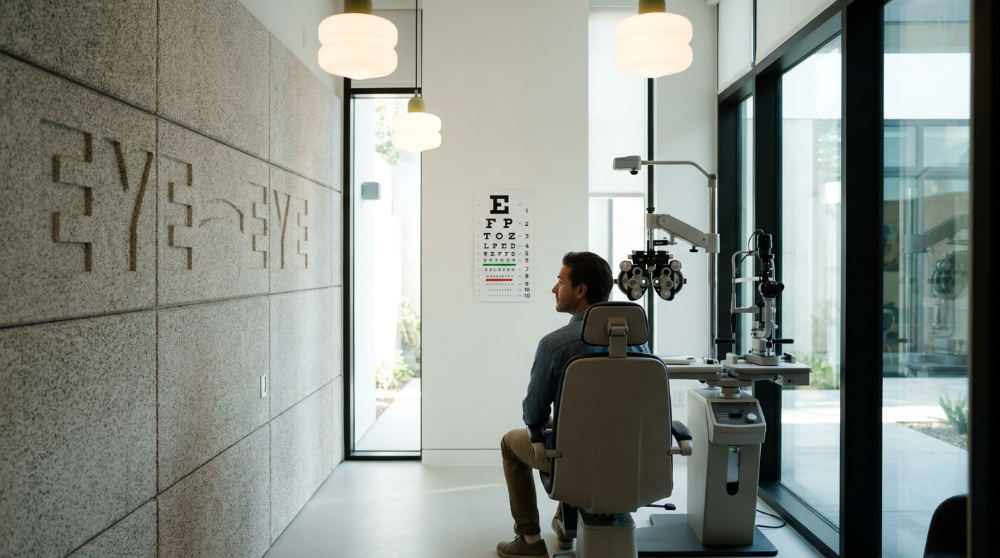
Herman Snellen developed this system using symbols called optotypes. These specifically designed block letters appear on the chart to test the resolution of the human eye. According to the American Academy of Ophthalmology, a standard Snellen eye chart usually consists of 11 rows of capital letters (with one large letter on the top row). These rows get progressively smaller as you move down.
Technical standards show that standard Snellen eye charts are typically 22 inches wide by 11 inches tall. While traditional physical charts are common, modern clinics often use digital versions or the logMAR scale for precision. Some specialized clinics also use an ETDRS Chart for uniform letter spacing. The test focuses strictly on visual acuity, which is the sharpness of your vision at a specific distance. At EYE EYE, we view these numbers through our "SEE GOOD All the Time" lens. We use them as the first step in a larger lifestyle conversation. They are never a final score.
Interpreting the Numbers for Your San Diego Lifestyle
Clear exam results allow you to understand how vision affects daily tasks like driving or recognizing faces. Your Snellen fraction serves as a clinical benchmark for your refractive error and overall visual sharpness.
A 20/20 vision meaning is the gold standard for clarity. However, it does not technically mean perfect vision. It ignores variables like contrast and light sensitivity. If you test at 20/15, your vision is sharper than average. You can see details at 20 feet that others need to be 15 feet away to resolve. This is a potential advantage for San Diegans who enjoy surfing at Sunset Cliffs, as spotting a wave set may be aided by distance resolution.
San Diego Rule: For those driving the busy I-5 or 163 corridors, maintaining adequate acuity is vital for safety and meeting regulatory standards.
A result of 20/40 is significant for locals. It relates to the clarity required for navigating urban environments like Bankers Hill. For art lovers visiting Balboa Park, higher denominators like 20/70 may indicate difficulty seeing fine textures in paintings. Understanding these numbers helps us translate clinical data into how you experience the city every day.
Visual Acuity vs Real World Vision
Advanced diagnostic technology in boutique practices provides deeper insights into eye health than Snellen fractions alone. The chart provides a quick measurement of resolution, but it does not tell the whole story of how your eyes function in the varied lighting conditions of Southern California.
| Snellen Fraction | Interpretation | Real-World Context |
|---|---|---|
| 20/20 | Standard Vision | Clear signage and faces at 20 feet |
| 20/15 | Above Average | Exceptional clarity for sports or detail work |
| 20/40 | Legal Minimum | Minimum for CA driver’s license without restrictions |
| 20/200 | Legally Blind | Large objects are visible, but fine details are lost |
A comprehensive exam is necessary to evaluate your eye health fully. Visual acuity is only one dimension. We use these results to determine if you may benefit from support for tasks like nighttime driving, reducing glare in bright offices, or tracking fast objects.
Prerequisites for an Accurate Snellen Reading
To ensure the diagnostic meaning of the fraction is preserved, the room must have standardized lighting. Clinics that offer this testing typically complete the process quickly. It is frequently included as a component of a comprehensive eye examination covered by vision insurance providers. You must be positioned exactly 20 feet from the chart. If not, the fraction loses its accuracy. You can even try a preliminary check using a free eye test chart online before visiting our Bankers Hill location.
1. Position yourself at the marked distance
Stand or sit at the 20-foot mark. This keeps the numerator of your Snellen fraction accurate. Small deviations in distance can significantly skew your results.
Accuracy depends entirely on this distance. The Snellen fraction assumes the numerator is a constant 20 feet. Keep your posture natural. Don’t lean forward. Doing so leads to an inaccurate measurement of your true acuity.
2. Cover one eye without applying pressure
Isolating each eye allows the examiner to identify if your visual acuity differs between your left and right eye. This is essential for identifying differences that might only affect one side of your visual field.
Use an occluder or the palm of your hand to block vision. It is crucial to avoid pressing on the eyelid (this can temporarily distort your vision when you switch eyes). This step ensures each eye is measured independently for its unique resolution capabilities.
3. Read the smallest line of optotypes visible
The goal is to identify the smallest line you can distinguish to determine your maximum resolution. This specific line becomes the denominator in your final visual acuity fraction.
Start from the top if necessary. Focus on identifying the smallest row where you can see the majority of letters clearly. Examiners look for the threshold where you can no longer accurately identify most characters on a given line. This identifies the limit of your visual resolution.
4. Repeat the process for the other eye
Vision often differs between eyes. Repeating the test for each eye helps ensure that your corrective lens options are tailored to your specific needs. Many people have different visual strengths in each eye.
Individual testing helps determine if one eye needs more support. This is particularly important when selecting independent designer frames that may require specialized lens thickness for different prescriptions. Once both eyes are tested, we may take a binocular reading.
Common Interpretation Mistakes and Limitations
Stylist Tip: If your Snellen denominator is high, your lenses may be thicker (our stylists specialize in choosing independent frames that mask lens edge thickness beautifully).
One frequent mistake is assuming 20/20 means your eyes are healthy. It only measures clarity. It does not provide information about eye pressure or retinal health. Many patients also accidentally memorize the top rows, leading to false results. Squinting during the test is another common error. This temporarily changes the shape of the eye and provides an inaccurate baseline. Ignoring the denominator is a mistake for those interested in fashion. Higher numbers in the denominator usually correlate with thicker lenses. This influences frame styling. At EYE EYE, we use these clinical insights to guide your frame selection process. We find styles that accommodate your visual needs while enhancing your personal aesthetic.
Moving Beyond the Chart in Bankers Hill
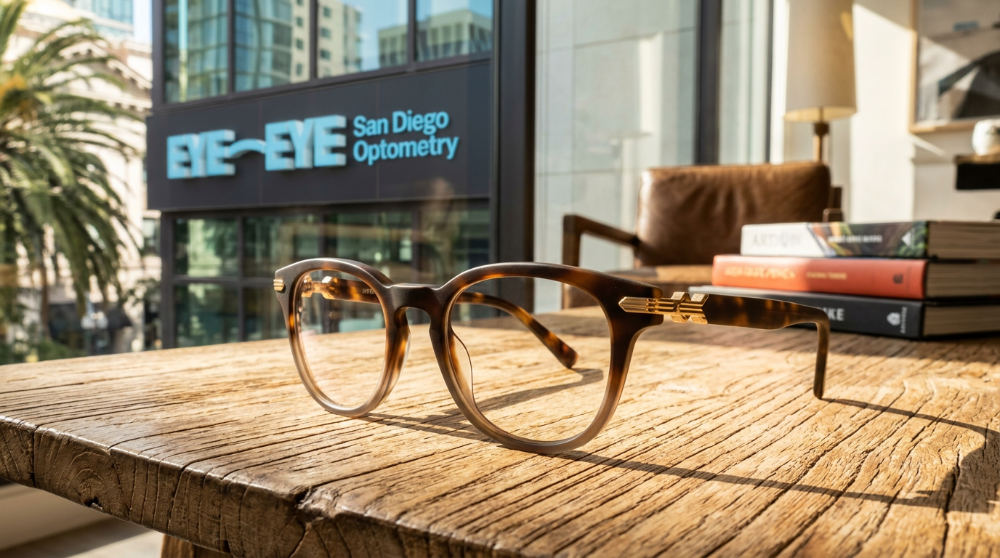
The Snellen chart is a classic tool. However, our independent practice utilizes advanced diagnostic technology for a holistic view of your vision. Interpreting your results is just the start of finding a pair of unique, handcrafted eyewear. A comprehensive exam supports your goal to "SEE GOOD All the Time" by addressing light sensitivity and lifestyle needs that a simple letter chart cannot detect. MDCalc suggests that visual acuity worse than 20/25 should be evaluated by a professional to determine if corrective lenses are appropriate.
If you are ready to move beyond the numbers and find a vision solution that fits your aesthetic, we invite you to experience a personalized approach to vision and style. Please book Appointments with our independent team. Reach out to us in Bankers Hill for more information. Call us at 619-815-5864.
Frequently asked questions
What do the numbers on a Snellen chart mean?
The first number represents the distance from the chart, which is standard at 20 feet. The second number is the distance at which a person with standard vision can read the same line. Together, this Snellen fraction describes the sharpness of your vision relative to a standard human eye.
Is 20/20 vision perfect?
No, 20/20 vision only means you have standard visual acuity at a distance. It does not measure other vital aspects of sight like peripheral vision, color perception, or depth perception. Some people even have 20/15 vision, which is sharper than the 20/20 standard.
Does 20/20 vision mean I don’t need glasses for reading?
Not necessarily, because 20/20 measures distance vision specifically. Near-vision changes like presbyopia, which typically develops with age, can affect reading even if your distance vision remains clear. A separate near-vision test is required to determine if you may benefit from reading glasses.
What is the 20/40 vision meaning?
A 20/40 result means you see at 20 feet what a standard eye sees at 40 feet. It is the common minimum requirement for obtaining an unrestricted driver’s license in California. It often indicates that corrective lenses may help with activities like driving or watching movies.
Can I fail a Snellen chart test?
It is not a pass/fail test; it is a measurement of your current visual state. A result indicating lower acuity simply means corrective lenses or further evaluation by a clinician are needed to help you see clearly. Regular updates are recommended to track changes in your vision over time.
Educational context only. This information is for general awareness and does not constitute medical advice or a diagnosis. Please consult with a qualified eye care professional for your specific health needs.